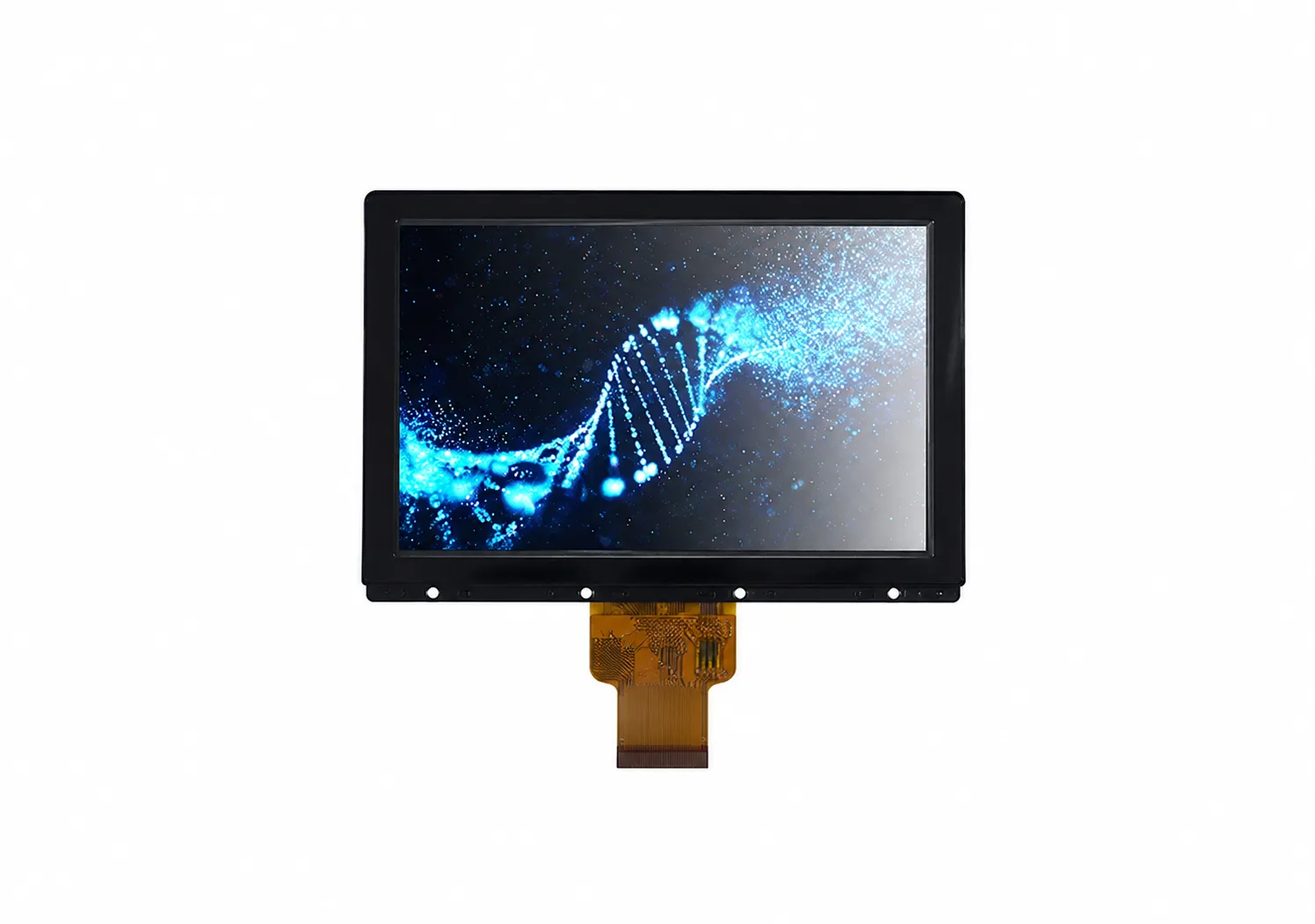
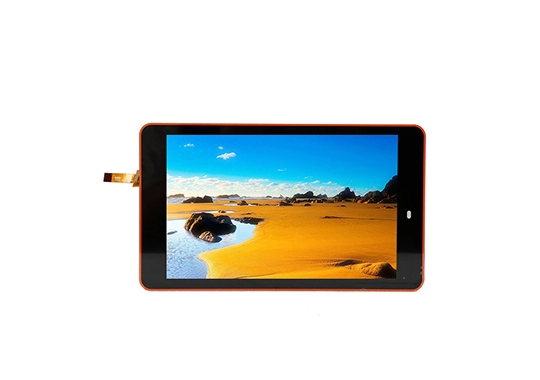
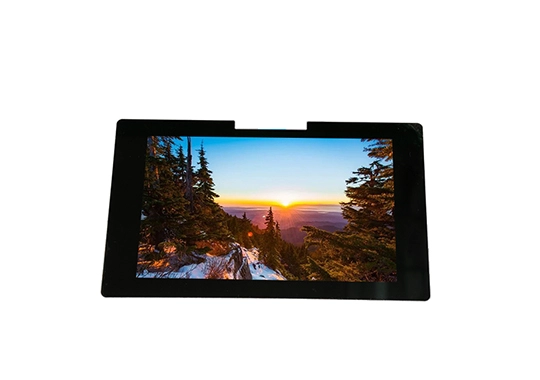
In many electronic products, the display is the first thing users notice—and the first thing they complain about when something feels wrong. Colors look washed out from the side, contrast drops under strong light, or the screen slowly develops faint “shadows” after months of use.Most of these issues are not defects. They are the result of choosing the wrong TFT LCD technology for the application.This article explains how TFT LCD displays work, how TN, IPS, and VA panels differ in real-world behavior, and how to select the right TFT LCD display module for industrial and commercial products.
A TFT LCD display is an active-matrix liquid crystal display in which each pixel is controlled by its own thin-film transistor. This may sound like a minor structural detail, but it fundamentally changes how the display behaves.In passive LCDs, pixels are addressed through shared rows and columns. This limits brightness, slows response time, and makes precise control difficult. In a TFT LCD, every pixel holds its state independently. As a result, the image is brighter, transitions are cleaner, and full-color graphics become practical.This is why TFT LCD technology has become the standard for modern user interfaces, from industrial HMIs and medical equipment to handheld terminals and consumer devices.
Many product specifications still use the term “LCD” very broadly. In practice, this can be misleading.Traditional passive-matrix LCDs are suitable for simple indicators and basic readouts. Once the interface includes graphics, touch interaction, or continuous operation, their limitations become obvious. TFT LCDs, by contrast, offer stable brightness, faster refresh, and much finer control over color and grayscale.For any product that relies on readability, responsiveness, or long-term visual consistency, TFT LCD is not an upgrade—it is a requirement.
Although all TFT LCDs use transistors, the way liquid crystals are aligned inside the panel has a major impact on viewing angles, color stability, and contrast. The three most common technologies are TN, IPS, and VA.
TN, or Twisted Nematic, is the oldest and most widely produced TFT LCD technology. Its biggest strengths are speed and cost. TN panels respond very quickly to voltage changes, which makes them attractive for applications where motion clarity matters and budgets are tight.The trade-off becomes apparent as soon as the viewing angle changes. Colors and contrast can shift noticeably, especially when viewed from above or below. TN panels are also prone to grayscale inversion, where brightness levels reverse at certain angles.Because of this behavior, TN TFT displays are best suited for applications where the viewing direction is fixed and well-defined, such as desktop monitors, embedded displays mounted at a known angle, or cost-sensitive industrial equipment.
IPS, or In-Plane Switching, was developed specifically to address the weaknesses of TN technology. By changing how liquid crystals rotate within the panel plane, IPS displays maintain consistent color and brightness even when viewed from extreme angles.In practical terms, this means fewer misreads, less eye strain, and a more predictable user experience. IPS panels also tend to perform better in touch-enabled systems, where mechanical pressure on the screen can cause visible distortions on TN displays.Although IPS TFT displays were once significantly more expensive, the cost gap has narrowed. For many industrial and professional products, the added stability and visual consistency justify the choice.
VA, or Vertical Alignment, panels sit between TN and IPS. Their defining feature is contrast. Blacks appear deeper, and high-contrast content stands out clearly, which can be useful for dashboards and information-heavy displays.However, VA panels typically have slower response times than TN and slightly narrower viewing angles than IPS. In applications with fast animations or camera feeds, this can result in motion smearing. VA TFT displays are often chosen when contrast is prioritized over speed or wide-angle viewing.
Rather than focusing on marketing claims, it helps to compare how different TFT monitor types behave once deployed..
| Feature | TN TFT | VA TFT | IPS TFT |
|---|---|---|---|
| Viewing angle behavior | Limited, direction-sensitive | Moderate | Stable and wide |
| Color consistency | Basic | Improved | High |
| Contrast | Lower | Very high | High |
| Motion performance | Excellent | Moderate | Good |
| Typical cost | Lowest | Mid-range | Higher |
Image persistence, sometimes called ghosting, usually appears after a display has shown static content for long periods. Logos, fixed icons, or unchanged layouts can leave faint residual patterns when the image changes.In real-world applications, this effect is influenced by panel technology, operating temperature, and usage patterns. Displays running continuously at higher temperatures tend to show these effects sooner. IPS panels generally exhibit less visible ghosting over time, which is why they are often preferred for long-duty industrial interfaces.
Grayscale inversion is most commonly associated with TN TFT displays. From certain angles, darker shades may suddenly appear lighter, or vice versa. This is not a defect but a characteristic of the technology.For this reason, TN panels are specified with a preferred viewing direction during the design phase. Ignoring this detail can lead to displays that look acceptable in testing but perform poorly once installed.
Most TFT LCD displays are transmissive, meaning they rely entirely on LED backlighting. This design provides high brightness but also increases power consumption, especially in outdoor environments.Transflective TFT LCDs combine backlight and ambient light, allowing better readability in sunlight while reducing power usage. Fully reflective TFT solutions are less common but are sometimes used in ultra-low-power applications where color performance is secondary.Backlight design plays a major role in sunlight readability, energy efficiency, and overall product lifespan.
Choosing a TFT LCD display should start with the application environment rather than the panel type name.Displays viewed from multiple angles benefit from IPS technology. Interfaces exposed to strong ambient light require careful backlight design. Products expected to operate continuously for years need stable thermal behavior and long backlight lifetimes.When these factors are considered early in the design process, the display becomes a reliable component rather than a source of future problems.
Is IPS TFT always better than TN TFT?
Not always. IPS offers better viewing angles and color stability, while TN remains a valid choice for fixed-angle, cost-sensitive designs.
Are TFT LCD displays being replaced by OLED?
In consumer electronics, OLED is growing. In industrial applications, TFT LCD remains dominant due to its durability, predictability, and long-term availability.
Can ghosting be prevented completely?
While it cannot be eliminated entirely, proper panel selection, stable operating temperatures, and thoughtful UI design significantly reduce the risk.
 English
 日本語
日本語 한국어
한국어 français
 Deutsch
 Español
 italiano
 русский
 português
 العربية
 Malay
Malay